A few months ago news reports on a recently-restored painting caught my attention. The “Last Supper” (ca. 1560) by Plautilla Nelli, a 7×2 meter canvas, went on public display at a museum in Florence for the first time! Nelli’s painting is the earliest known example of this theme painted by a woman. I also learnt, to my astonishment, that Nelli was self-taught, and a nun! Her Dominican convent became financially self-sufficient thanks to the many commissions she received. Her fame during her lifetime (and a mention by Giorgio Vasari) did not prevent her from falling into oblivion. The merit of Sister Nelli’s reinstatement in her rightful place in Renaissance art goes to Advancing Women Artists (AWA), an American charity run by women. Their achievements in retrieving neglected women’s works are well conveyed in a short video (here).
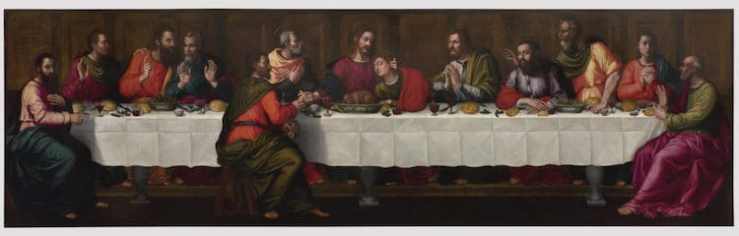
The restored ‘Last Supper’ by Plautilla Nelli (1542-1588). Photo credit: mymodernmet.com (here)
In the last 20 years or so scholarship has unearthed a wealth of artistic female talents within Italian convents – painters, composers, poets, playwrights – reclaiming the important role of these religious institutions as cultural centres during the Renaissance and beyond (see Pomata and Zarri 2005). In this period convents started to promote intellectual pursuits among the nuns, gradually expanding their library collections beyond devotional literature. Some convent libraries became larger than those in monasteries, as they also accepted unpublished manuscripts by women, and works in the vernacular, both of which were not normally collected in monasteries. In short, convent libraries “contained some of the only literature by, for, and about women” (Sigmon 2011, 81). Could convent libraries perhaps be seen as the first women’s libraries in Italy?
What is certain is that today’s women’s libraries are a legacy of second-wave feminism, and emerged in most Italian cities from the late 1970s. Like those in other European countries, their role is to “preserve the heritage of women and their movements, and to contribute to emancipation through disseminating knowledge about gender issues” (De Jong and Wieringa 2013, 13). In the mid-1980s prominent Italian Women Documentation Centres, Libraries and Archives formed a network called Lilith (here), which produced databases (Sever Donne here) and addressed information-specific problems to do with metadata, documentation, thesauri, etc. from a feminist perspective (more info here). Lilith today brings together 40 Women’s Libraries and among them the Biblioteca Italiana delle Donne (here) in Bologna has become the major Italian library specializing in women’s culture, gender studies and feminism. Its extensive collections (including digital ones) range from 16th-century printed books, to photographs, posters, national and international periodicals, and more. Among their special collections, we find books for young girls and Rosi Braidotti’s donation of 350 volumes on feminist theory. Managed by Bologna City Council in partnership with the non-profit organization Orlando, it is a highly specialized research library, equipped with the latest technology. It is also a public library with a tea room, a rich programme of events, talks, readings, and information literacy workshops.
And it is located in a wonderful, central spot, in the former convent of Santa Cristina!
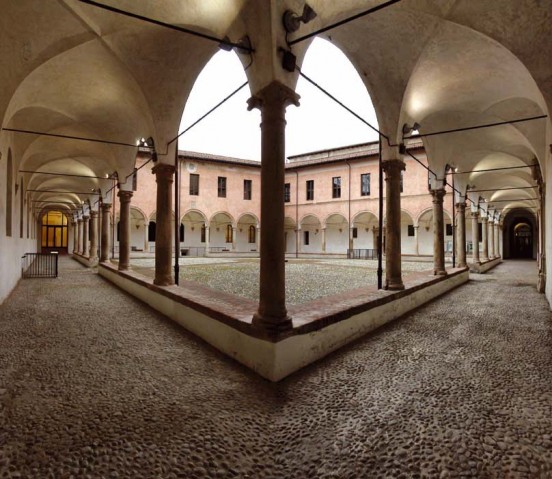
The Women’s Library in Bologna. Photo credit: Biblioteche Bologna (here)
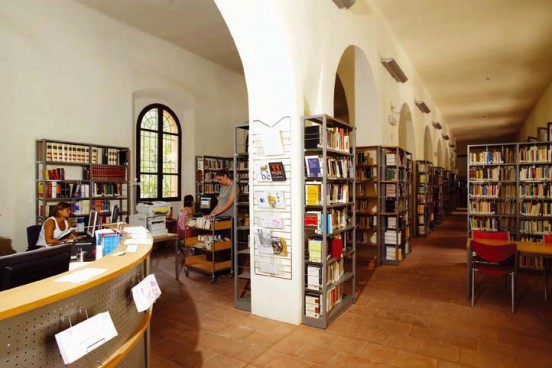
Inside the Women’s Library in Bologna. Photo credit: Biblioteche Bologna (here)
Bibliography
Canfailla, Martina (2019), “Il restauro dell’Ultima cena, il dipinto della prima pittrice fiorentina: Plautilla Nelli”, La Repubblica, 18 October (here)
Morehead, Joanna (2019). “Restored to glory: How a 16th-century nun regained her place in art history”, The Guardian, 19 October (here)
Pomata, Gianna and Gabriella Zarri (ed) (2005). I monasteri femminili come centri di cultura fra rinascimento e barocco, Rome: Edizioni di storia e letteratura.
Sigmon, Rebecca A. (2011). “Reading like a nun: The composition of convent libraries in Renaissance Europe.” Journal of Religious & Theological Information, 10 (3-4), 81-102. DOI: 10.1080/10477845.2011.595663
 the accidental library apprentice